
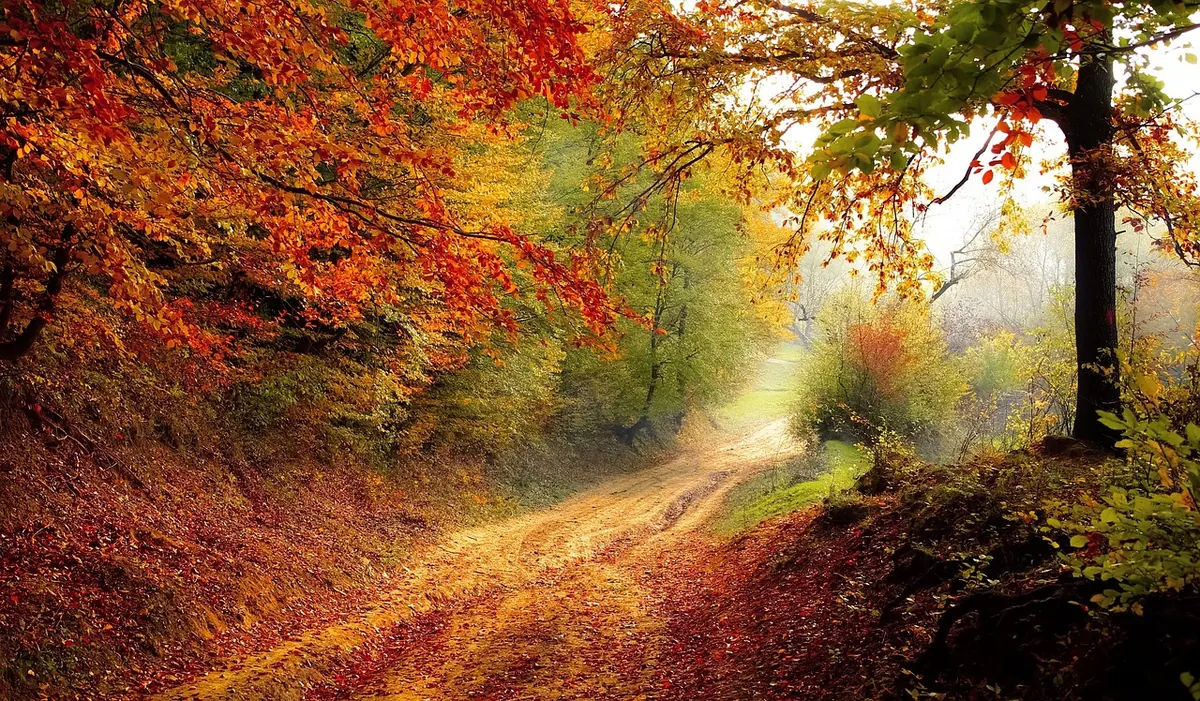
A sugar maple in July is a factory running three shifts. Its leaves are packed with chlorophyll, the green molecule that captures sunlight and turns it into sugar, and there is so much of it that the whole canopy reads as a single colour. Then the nights get longer, the air cools, and the tree begins an orderly shutdown that ends with every one of those leaves on the ground. What happens in between is one of the best free science shows going.
Most of the colours were there all along, or can be built in a week or two from sugar that never makes it out of the leaf. Whether a given tree turns crimson, gold, bronze or a tired brown depends on the species, on the weather in the six weeks before peak colour, and on a few small quirks of where that tree happens to stand.
The Green Machine Powers Down
Shorter days are the reliable trigger. As the photoperiod shrinks past a threshold that varies by species and latitude, the tree stops repairing its leaves and starts disassembling them. Cool nights speed the process along, but day length is what sets the calendar.
Chlorophyll is expensive to build, which is why the tree takes it apart instead of simply letting it fall. Before the leaf drops, much of the nitrogen and phosphorus is pulled back through the veins into twigs and roots, to be spent on next spring's buds. At the same time a layer of corky cells — the abscission layer — forms at the base of the leaf stalk and gradually pinches off the plumbing. Water and minerals stop arriving. Sugar made in the leaf has nowhere to go.
That trapped sugar is the raw material for the best part of the show. Once chlorophyll begins to break down, the yellows and oranges that were sitting underneath it become visible. Nothing new is manufactured; an old colour is simply unmasked. This is why birches and ginkgos seem to switch on almost overnight.
Four Pigments, Four Colours
A leaf's final colour is a competition between four groups of chemicals, each with different habits:
- Chlorophyll — green, abundant, and the first to go. Its collapse is what opens the curtain for everything else.
- Carotenoids — the xanthophylls and beta-carotene that give yellow and orange. They are present in the leaf all summer, tucked into tiny structures called plastids, hidden by the green. The same molecules colour carrots, corn and egg yolks.
- Anthocyanins — reds, pinks and purples. Unlike the others, these are usually not there in summer. They are manufactured in autumn, inside the watery cell sap, from sugars stranded in the leaf. Making them costs energy and requires light, which is a strange thing to do with a leaf you are about to throw away.
- Tannins — brown. As cells break down, tannins oxidise and bind with other compounds, producing the dull oak-and-beech brown that marks the end of the season.
Because yellow pigments sit in one part of the cell and red anthocyanins in another, a leaf can show both at once. Filter yellow through red cell sap and you get orange, or the scarlet-to-amber blend that makes a good sugar maple look lit from within.
What Separates a Crimson Year From a Dull One
Only species capable of making anthocyanins can turn truly red, and among those, weather decides how much they bother. The recipe is bright, sunny days plus cool nights that stay above freezing.
Sun keeps photosynthesis running, so the leaf keeps producing sugar. Cool nights slow the export of that sugar and favour anthocyanin production. A run of warm nights and the red fades toward pink or washes out entirely. An early hard freeze kills the tissue outright, and instead of red you get brown leaves that drop within days.
Cloud cover matters for the same reason. A grey September means less sugar, less pigment, more muted colour. Drought is the other spoiler: trees under water stress often shut down early, browning and dropping leaves while the calendar still says summer. Wind and heavy rain don't change any pigment; they just strip the leaves before you get to look at them.
Why one tree outshines its neighbour
Stand at the edge of a woodlot and you can often see this working. Trees on the sunny southern edge, with no competition for light, make more sugar and tend to colour more strongly than the same species in the shaded interior. Cold air pooling in a hollow can push one pocket of trees a week ahead of the ridge above. Individual genetics matter too: two red maples a few metres apart can differ noticeably in both shade and timing. And young, fast-growing trees sometimes colour later than old ones.
Not Every Tree Is Trying to Be Scarlet
Maples
Sugar maples are the showstoppers, mixing scarlet, orange and gold on one crown. Red maples are more consistently crimson and turn earlier, sometimes while it still feels like late summer. Silver maples go yellow and drop quickly.
Oaks, beeches and hickories
Most of these largely skip the red. Their autumn palette is bronze, russet and deep gold, held on the tree longer than maples — which is why oak leaves rattle in the wind in December. Red oaks can manage a dull brick red.
Birches, aspens and ginkgos
Pure carotenoid territory: clean yellow, sometimes almost lemon, with no red at all. Ginkgo is worth watching for the synchronised way a whole tree drops its leaves within a day or two of the first hard frost.
Ash, dogwood, sweetgum, sumac and sassafras
These are the purple-and-wine crowd. Sumac and sassafras are among the earliest to turn, often in the first half of September; sweetgum works through yellow, orange and plum, sometimes on a single branch.
How to Time a Leaf-Peeping Weekend
- Start with species. A forest of beech and oak will never give you crimson, no matter how perfect the weather. Check what actually grows where you're going before you book anything.
- Watch the nights from early September. A stretch of clear days and cool, frost-free nights is the signal to plan your trip for roughly two weeks later.
- Check late-summer rainfall. A dry August tends to push an early, short, brownish season; a normal one keeps the schedule on track.
- Follow elevation and latitude. Colour moves downslope and southward over several weeks. High ground first, valleys later.
- Pick a calm, sunny window. Pigment peaks before the leaf does — a windy, wet weekend can end the season early.
- Go for edges. Roadsides, field margins and lakeshores give you sunlit, stressed trees that colour hardest, plus a view.
Keep the Colour a Little Longer
If you want to bring some of it home, collect leaves on a dry day, when they are free of dew, and press them between newspaper under a heavy book for a week or two. A sheet of wax paper and a warm iron works faster for children, and a quick dip in melted paraffin seals a leaf well enough to hang it. Glycerin, sold at craft shops, can replace the water in a leaf and keep it supple for months.
Whatever you do, expect the colour to fade. Anthocyanins are fragile and break down in light, which is why a pressed red maple goes brown in a sunny window. Keep your collection in a drawer, photograph the trees you can't carry, and remember that the brown at the end of the season is not a failure — it is simply the last pigment standing.
Photo: Valiphotos / Pixabay