
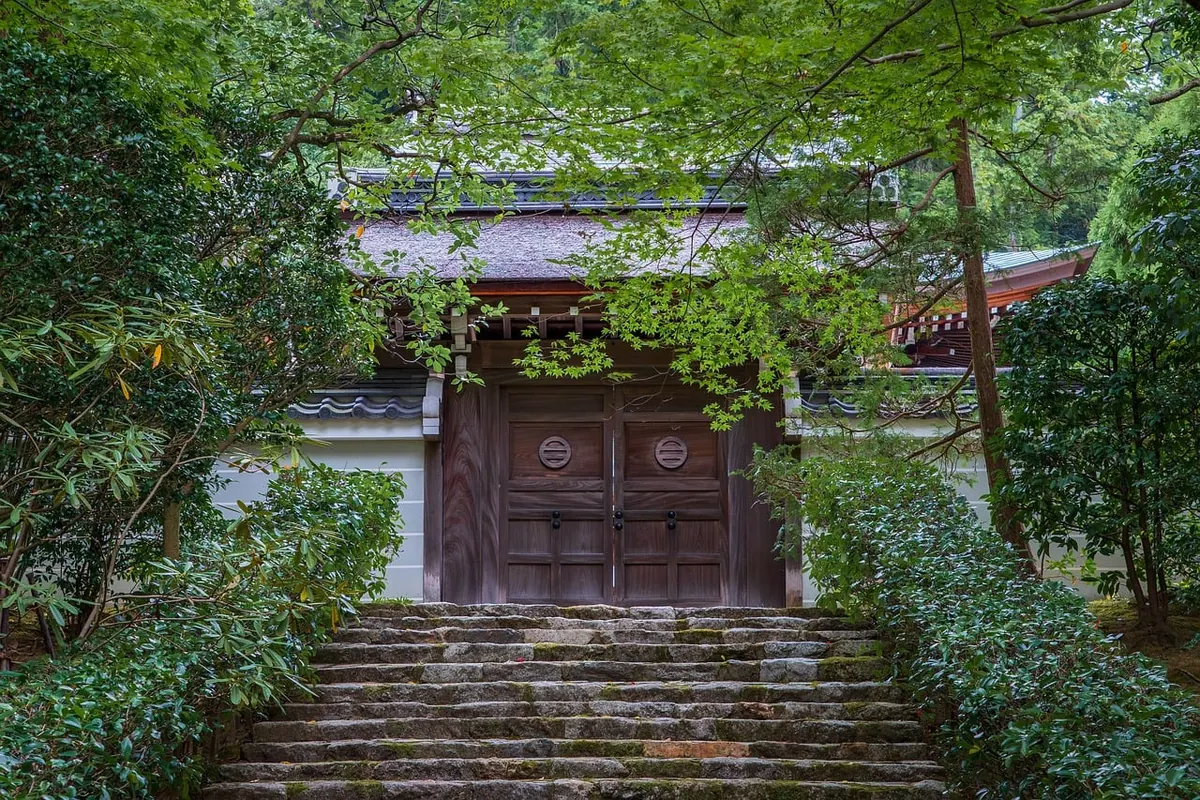
The gravel crunches underfoot, the gate rises out of the trees, and ahead of you someone is rinsing their hands at a stone basin. You want to do this properly. You also don't want to be the person who claps in a Buddhist hall, or scrubs up like a surgeon while a queue builds behind them.
Temple etiquette in Japan isn't a secret code. It comes down to a handful of habits, most of them about the same three things: respect, cleanliness, and not making yourself the main event. Here are the seven slips first-time visitors make most often, and what to do instead.
Mistake one: treating the temizuya like a sink
That stone basin near the entrance is the temizuya; the long-handled ladle resting on it is a hishaku. The ritual is a small symbolic wash of hands, mouth and handle, not a full wash-up. The usual errors: drinking from the ladle, lathering up, and forgetting the handle that the next person has to hold.
- Take the ladle in your right hand and scoop one ladleful of water.
- Pour a little over your left hand.
- Switch the ladle to your left hand and pour a little over your right.
- Pour water into your cupped left palm, rinse your mouth, and spit discreetly beside the basin. Never drink from the ladle.
- Turn the ladle upright so the last of the water runs down the handle, then set it back.
One ladleful is enough. If a queue has formed, don't linger, and if the basin is crowded, walking on respectfully beats improvising. This happens before you approach the main hall, not after.
Mistake two: throwing coins like a slot machine
You'll see it at any busy temple: someone takes a step back and lobs a coin at the offering box. The saisen box takes a small offering, not an entrance fee and not a tip, and there is no correct amount. Five-yen coins are popular because go-en sounds like "good connection", but nobody is counting.
Step up close, drop the coin in gently, and move on. If a bell rope hangs above the box, a light pull is usually appropriate before you pray; don't swing on it or ring it twice for effect. Keep a few small coins loose in your pocket — many temples charge a small fee for inner halls and the stamp counter, and you shouldn't count on paying by card.
Mistake three: botching the incense, or avoiding it entirely
The big bronze burner in the courtyard is a jokoro, and the smoke drifting over it is meant to be good for you: people waft it toward a stiff shoulder or over their head. Joining in is optional, and no one will nudge you if you walk past. If you do want to take part, buy a small bundle from the counter, light a stick, let it catch, then stop the flame by fanning it with your hand. Blowing on it is the classic error.
Waft a little smoke toward yourself — one or two passes, not a full-body fumigation — then step aside so the next person can get near the burner. Don't reach across someone else's incense, and don't wave the smoke away from your face as if it were bonfire smoke. If you wear contact lenses or have a cough, standing a step back is perfectly fine.
Mistake four: clapping at a temple
Here's the distinction that trips up almost everyone. A torii gate — the tall post-and-lintel structure, often vermilion — marks a Shinto shrine. A temple is Buddhist, and you'll know it by the incense burner, the statues, the great bronze bell, often a gate flanked by guardian figures. The etiquette differs, and the difference is audible.
At a shrine, the common pattern is: bow twice, clap twice, pray, bow once. At a temple, you generally keep your hands together in silent prayer and bow. No clapping. Some temples and some Buddhist sects make exceptions, but the safe default is quiet. Clapping loudly before a Buddhist altar is roughly the equivalent of starting a round of applause in a library.
If someone is already praying, wait or pray beside them rather than stepping in front. Keep it short, and don't turn away mid-bow to check your phone.
Mistake five: treating the whole place as a photo studio
Photography rules vary enormously from temple to temple and are almost always posted: a camera icon with a slash, a small sign at the hall entrance, a rope across a doorway that means stay out. The mistakes are consistent. Flash inside a hall. A tripod planted in the middle of a gravel path. A phone held over a worshipper's head for a shot of the altar.
Read the signs before you lift the camera. Where photography is allowed, it usually covers the buildings and gardens, not the statues or the inner sanctuary. Keep the shutter quiet, stay out of the approach path, and skip the shot if it means photographing someone mid-prayer. If you aren't sure about a particular hall, ask at the counter or simply don't.
Mistake six: behaving as though the grounds are a public park
Shoes come off at raised wooden halls — look for the racks and the plastic bags provided for carrying them. Beyond that: no eating on the move, no phone calls, no leaning on old pillars, no touching statues or climbing a stone lantern for a better angle. Snacks and bottles stay in the bag until you find a bench.
Keep your voice low without turning it into theatre. A quiet speaking voice is fine; a whisper that carries across the courtyard is not an improvement. Follow the Japanese visitors around you — where they stop, where they take their shoes off, where they queue — and you'll get it right most of the time.
Mistake seven: getting through the visit without actually arriving
The last mistake is speed. Temples get slotted in as a photo stop between lunch and the next train, and people walk the whole precinct in six minutes with the phone out. The result is pictures of a gate and no memory of the place.
Give one temple twenty minutes instead of four temples six minutes each. Sit on a bench facing the main hall. Read the signboard at the entrance, which usually explains what the place is and why it's here. If a ceremony is under way, don't walk through it or film from the doorway; wait at the back or come back later. And turn around at the gate on your way out — it's a different building from that side.
Before you step through the gate
Rules shift with the sect, the site and the season, so treat this as a starting point rather than a rulebook.
- Keep a few small coins loose in a pocket rather than buried in a purse.
- Read the signs at the entrance; they cover shoes, photos and closed areas.
- Use the shoe bags provided, and carry your shoes instead of leaving them in a heap.
- Put your phone on silent, and take calls outside the precinct.
- Watch the person in front of you; local visitors are the best guide.
- When in doubt, do less: quieter voice, fewer photos, shorter prayer, smaller offering.
If a sign contradicts anything here, follow the sign. The etiquette exists to keep a working religious site working — get that part right and the rest is detail.
Photo: ChiemSeherin / Pixabay